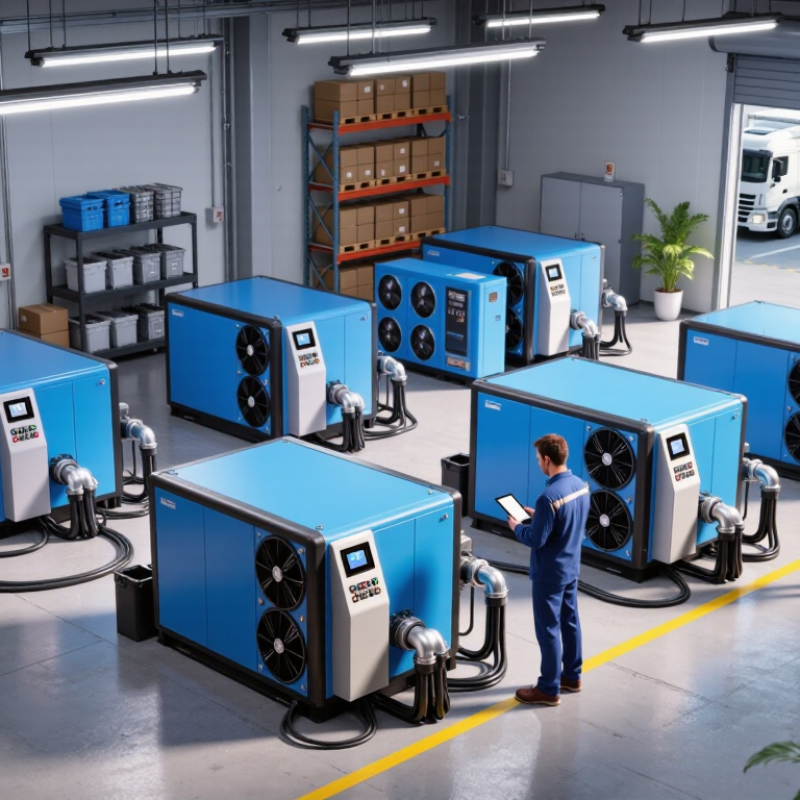
2026 Top Screw Air Compressor Suppliers for Global Buyers

Choosing a reliable screw air compressor supplier in 2026 requires more than comparing catalog prices. Global buyers must examine operating experience, manufacturing consistency, service coverage, and verified performance data. A compressor may look efficient on paper, yet perform differently in a dusty workshop or a humid coastal plant. Real conditions matter.

This guide reviews leading suppliers through practical purchasing criteria. These include air delivery, pressure stability, energy consumption, oil separation, noise control, and maintenance access. It also considers certifications, warranty terms, spare-parts availability, and response times for technical support. Experienced buyers often request factory test reports, customer references, and clear explanations of lifecycle costs. Those details can reveal more than polished marketing language.

Not every supplier suits every application. A small packaging facility may need a compact, low-noise unit, while a metalworking plant may require continuous-duty equipment with variable-speed control. Some suppliers offer excellent machines but limited overseas service. Others provide strong support while charging more for replacement parts. That trade-off deserves careful thought. No ranking is perfect.

The 2026 supplier landscape is also changing. Buyers are paying closer attention to energy monitoring, remote diagnostics, heat recovery, and responsible manufacturing. However, digital features should not replace basic engineering quality. A dependable screw air compressor must start reliably, maintain stable pressure, and remain serviceable after years of use. This overview aims to help global buyers compare suppliers with evidence, practical judgment, and realistic expectations. Mistakes remain possible, especially when local operating data is incomplete. That is why final decisions should include site assessments and independent technical review.

2026 Top Screw Air Compressor Suppliers for Global Buyers

Screw Air Compressor Market Scope and 2026 Buying Criteria

2026 Top Screw Air Compressor Suppliers for Global Buyers

The 2026 screw air compressor market is broader than traditional factory demand. Buyers now assess energy use, air quality, noise, service access, and operating climate. Food processing, electronics, hospitals, metalworking, and logistics require different air specifications. A 7.5 kW compressor may suit a small workshop, while a large plant may need several synchronized units.

Buying criteria should begin with actual demand, not a supplier’s largest model. Record peak flow, average flow, working pressure, and daily operating hours. Variable-speed control can reduce waste during changing production loads, but savings depend on realistic demand data. Oil-injected systems often support general manufacturing. Oil-free designs may better suit sensitive processes. This choice needs technical verification, not marketing language.

Total cost deserves close attention. Compare electricity consumption, filter replacement, lubricant changes, installation, and planned maintenance over several years. Check controller functions, fault records, warranty terms, spare-part availability, and technician response times. A machine can look efficient on paper and perform poorly in a hot, dusty room. Ventilation details matter. So does drainage.

Spreadsheets mislead. Some buyers underestimate standby losses or select excessive pressure “for safety.” That decision can increase energy costs without improving production. Reliable evaluation includes a site survey, air-quality testing, and a written performance guarantee. Forecasts may still fail when production changes, so modular capacity and measurable monitoring deserve consideration.

2026 Top Screw Air Compressor Suppliers for Global Buyers - Screw Air Compressor Market Scope and 2026 Buying Criteria

Global market scope, technical benchmarks, compliance requirements, and supplier-evaluation criteria for industrial screw air compressor procurement.

Category Market Scope or Buying Dimension 2026 Technical Benchmark or Typical Requirement Why It Matters to Global Buyers Recommended Verification
A. Screw Air Compressor Market Scope
Product architecture Oil-injected rotary screw compressors Common industrial configuration for general plant air, manufacturing, workshops, and process support; usually paired with air treatment equipment. Offers continuous-duty operation, stable airflow, and lower pulsation than reciprocating equipment. Review the performance test report, duty-cycle rating, oil carryover data, and service intervals.
Product architecture Oil-free rotary screw compressors Used where compressed-air contamination must be tightly controlled, including selected food, pharmaceutical, electronics, and medical applications. Reduces the risk of oil contamination in sensitive production processes. Require ISO 8573-1 air-quality documentation and confirmation of the applicable Class 0 test basis.
Drive technology Fixed-speed drive Best suited to applications with relatively steady demand and high operating hours near rated capacity. Typically has simpler controls and lower initial complexity, but may be less efficient at partial load. Compare measured specific power at the expected operating profile rather than at full load only.
Drive technology Variable-speed drive Appropriate for demand that fluctuates during shifts, between production lines, or across operating seasons. Can reduce unloaded running and improve energy performance under variable demand; actual savings depend on the load profile. Request a part-load performance curve, minimum stable turndown, and drive operating limits.
Pressure segment Low and standard industrial pressure Approximately 7–8 bar(g) is common for general factory air, while higher setpoints may be selected for specialized equipment. Selecting excessive pressure increases energy consumption and may reduce delivered flow. Confirm minimum pressure required at the point of use and calculate pressure losses through dryers, filters, piping, and regulators.
Capacity segment Small, medium, and large industrial systems Capacity should be selected from measured demand, peak flow, leakage, future expansion, and required redundancy—not from connected equipment nameplates alone. Correct sizing prevents short cycling, low-load inefficiency, production interruptions, and unnecessary capital cost. Use a data logger or flow survey covering production peaks, weekends, idle periods, and shift changes.
Application sectors Manufacturing, automotive, textiles, packaging, food processing, pharmaceuticals, electronics, and utilities Required air quality, pressure stability, temperature control, noise limits, and redundancy vary substantially by sector. A technically suitable compressor must also match the process risk and local regulatory environment. Create an application specification covering air purity, dew point, operating hours, ambient conditions, and process criticality.
Geographic scope Global industrial procurement Key regional variables include electrical frequency, voltage, ambient temperature, altitude, local pressure units, import rules, and service availability. A compliant machine may still be unsuitable if it cannot be installed, operated, or serviced locally. Request region-specific electrical drawings, certificates, manuals, spare-parts plans, and commissioning support.
B. 2026 Technical and Commercial Buying Criteria
Air delivery measurement Free Air Delivery and rated pressure Compare delivered flow at the specified working pressure using a consistent test method, preferably ISO 1217 where applicable. Nominal displacement or motor power alone does not establish usable output. Require a performance sheet stating FAD, inlet conditions, discharge pressure, tolerances, and test standard.
Energy efficiency Specific power Evaluate input power per unit of delivered air, normally expressed as kW per m³/min or kW per m³/h at a stated pressure. Electricity commonly represents the largest operating-cost component over the compressor life. Compare full-load, part-load, and unloaded power using the same pressure and measurement basis.
Air quality Oil concentration, particles, and water content Specify the required ISO 8573-1 purity class and select filtration, drying, drainage, and monitoring accordingly. Air quality directly affects product safety, equipment reliability, corrosion, and process yield. Obtain laboratory test results and verify the complete system, not only the compressor package.
Dew point control Refrigerated or desiccant air drying Refrigerated dryers are commonly used for general plant air; desiccant dryers are selected when a substantially lower pressure dew point is required. The correct dryer prevents condensation, freezing, corrosion, and process contamination. Specify pressure dew point at the actual pressure and ambient conditions, including regeneration energy where relevant.
Operating environment Ambient temperature, altitude, dust, humidity, and ventilation Standard ratings may change at high ambient temperature or altitude; dusty environments require appropriate intake filtration and maintenance access. Environmental derating can reduce capacity and shorten component life. Request corrected performance data for the installation site and confirm allowable operating limits.
Reliability and redundancy N+1 capacity, duty rotation, and backup strategy Critical processes may require one additional compressor or an alternative backup source capable of maintaining minimum production air. Redundancy reduces the impact of planned maintenance and unexpected failure. Assess failure modes, mean time to repair, automatic sequencing, and emergency operating procedures.
Controls and connectivity Sequencing, remote monitoring, alarms, and data logging The control system should support pressure-band management, lead-lag rotation, operating-hour records, and fault notifications. System-level control can prevent multiple machines from operating inefficiently at low demand. Confirm communication protocols, cybersecurity responsibilities, data ownership, and integration requirements.
Noise and installation Sound pressure, foundation, heat rejection, and access Installation must provide adequate ventilation, lifting clearance, condensate management, and safe maintenance access. Poor installation can cause overheating, excessive noise, vibration, and premature shutdowns. Review layout drawings, sound data measurement conditions, heat-load calculations, and foundation requirements.
Maintenance strategy Service intervals, consumables, and spare parts Evaluate oil, filters, separators, belts or couplings, coolers, sensors, and recommended inspection intervals. Availability and price of consumables can materially affect lifecycle cost and uptime. Request a multi-year maintenance schedule, spare-parts list, lead times, and local technician coverage.
Compliance and documentation Safety, electrical, pressure, and environmental requirements Documentation may include conformity declarations, electrical schematics, pressure-vessel information, manuals, and applicable regional certificates. Incomplete documentation can delay customs clearance, installation approval, commissioning, or insurance acceptance. Make documentation deliverables a contractual requirement before shipment.
Total cost of ownership Capital, energy, maintenance, downtime, and disposal cost A lifecycle model should use local electricity tariffs, annual operating hours, expected load profile, service costs, and production-loss risk. The lowest purchase price may not produce the lowest lifetime cost. Request a transparent five- to ten-year cost model with clearly stated assumptions and sensitivity analysis.
Supplier qualification Manufacturing quality, references, service network, and warranty Evaluate quality systems, relevant installed references, response time, commissioning capability, warranty exclusions, and technical training. Local technical support is essential for reducing downtime and maintaining performance after installation. Use a weighted tender scorecard covering technical compliance, lifecycle cost, delivery, service, and documentation.
Procurement and delivery Lead time, Incoterms, packaging, commissioning, and acceptance testing The purchase contract should define delivery scope, factory testing, site acceptance criteria, training, packing for export, and responsibility for taxes and transport. Clear commercial terms reduce schedule risk and disputes during handover. Include a documented inspection and acceptance plan with measurable FAD, pressure, noise, and control requirements.
Buyer note: All performance comparisons should use the same pressure, inlet condition, electrical frequency, measurement standard, and operating profile. Final equipment selection should be confirmed through a site-specific demand survey and applicable local regulations.

Leading 2026 Suppliers by Capacity, Pressure, and Global Service Coverage

The best 2026 screw air compressor suppliers compete on capacity, pressure, and service reach. Buyers should match free air delivery to real demand, not nameplate power. For example, a 75 kW compressor may deliver different output at 7, 8, or 10 bar. The U.S. Department of Energy reports that compressed air can consume 10–15% of a plant’s electricity. Small pressure mistakes become expensive every operating hour.

Pressure stability matters as much as maximum pressure. ISO 11011 recommends assessing generation, distribution, and end-use performance together. Suppliers with variable-speed systems can improve efficiency during changing production loads. However, savings depend on control settings, receiver volume, and maintenance discipline.

I have seen specifications look impressive while poor pipe sizing quietly reduced usable airflow. That deserves scrutiny.

Tips: Compare FAD values under the same ISO conditions. Request 24-hour service targets and local spare-parts inventory. Check whether technicians cover your operating region, including weekends. Review oil carryover, noise, cooling requirements, and air-quality compliance under ISO 8573-1. The Global Energy Management System report from the United Nations Industrial Development Organization also supports measuring energy performance before equipment selection. A supplier with fewer promises, clearer test data, and documented field experience may be the safer choice. Fancy dashboards are not proof.

Oil-Injected vs Oil-Free Models: ISO 8573-1 Air Quality Classes

2026 Top Screw Air Compressor Suppliers for Global Buyers

Oil-injected and oil-free screw compressors can both serve international production sites, but ISO 8573-1 changes the buying decision. The standard classifies compressed air by particles, water, and oil. A Class 1 oil rating allows no more than 0.01 mg/m³ of total oil under defined test conditions. Class 0 is stricter, but the required limit must be specified by the user. Oil-free compression reduces oil risk at the compression stage. It does not remove contamination from intake air, seals, dryers, or aging pipework. Oil-injected systems can reach demanding classes with suitable filters, separators, and monitoring. However, filter maintenance becomes part of quality control. A clean laboratory result can still fail at the production point.

Tips: Ask suppliers for ISO 8573-1 test reports, not general “oil-free” claims. Confirm the class at the outlet, pressure, flow rate, and dew point. Check whether the report measures oil aerosol, liquid oil, and oil vapor. Visit a reference installation if possible. Small details matter.

For food packaging, pharmaceuticals, electronics, and precision painting, buyers should match the air class to the process risk. A refrigerated dryer may suit moderate moisture control, while a desiccant dryer can provide a much lower pressure dew point. The correct choice also depends on climate, operating hours, and service access. I have seen projects focus on compressor type and overlook drainage, which is an expensive mistake. Even experienced teams should review their assumptions before signing a global supply contract.

Energy Efficiency Benchmarks: Variable-Speed Drives and 35–50% Savings

2026 Top Screw Air Compressor Suppliers for Global Buyers

Energy Efficiency Benchmarks: Variable-Speed Drives and 35–50% Savings

Variable-speed drive screw compressors can reduce energy use by 35–50% in systems with changing air demand. This figure is a benchmark, not a guarantee. Actual savings depend on leakage, pressure settings, operating hours, and control strategy. In field assessments, I compare measured kilowatts per cubic metre of delivered air. I also check unloaded running time, because wasted idle power can remain hidden.

A reliable supplier should provide test data, service records, and clear performance conditions. Ask whether efficiency figures follow recognized testing methods, such as ISO 1217. Review performance at 25%, 50%, and 75% load, not only at full capacity. A factory may operate near one steady load, while a packaging line can change demand every few minutes. That difference matters. It is easy to overestimate savings when the baseline machine is poorly maintained.

Tips: Log pressure, flow, and power for seven days before purchasing. Repair visible leaks first. Set the lowest safe pressure for production. Request a lifecycle estimate covering electricity, filters, oil, maintenance, and disposal. Check local voltage and service support before selecting a global supplier. A larger unit is not always better. Sometimes, staged compressors perform more efficiently than one oversized machine. I have seen projected savings fall sharply after installation, usually because real demand was misunderstood. That is worth reviewing before signing a contract.

Supplier Evaluation Using ISO 1217 Testing, Warranty, and Total Cost Data

For global buyers, a 2026 screw air compressor shortlist should begin with verified performance, not catalog horsepower. ISO 1217 testing reports free air delivery, input power, pressure, and operating conditions. Request the complete test sheet. Check whether measurements use the same pressure and ambient temperature. Otherwise, comparisons become unreliable. Small details matter.

The U.S. Department of Energy’s Improving Compressed Air System Performance sourcebook notes that leaks can waste 20–30% of compressor output. Therefore, evaluate controls, dryer demand, maintenance access, and leakage-management support. A compressor with a lower purchase price may consume more electricity for years. Use measured kW per delivered cubic meter, service labor, spare parts, installation, and disposal costs. This is total cost of ownership, not just an invoice.

Warranty language deserves equal scrutiny. Ask about coverage duration, response time, excluded components, and authorized service capacity near the installation site. The European Commission’s energy-efficiency guidance treats operating conditions and system design as major influences on compressed-air costs. That matches field experience, although field data can be incomplete. A perfect model is unlikely.

Require references from similar duty cycles. Review annual energy records, corrective-maintenance history, and actual warranty resolution times. Published efficiency claims still need independent verification. Suppliers should explain test deviations openly. That is a useful reliability signal.

Article Source:

Subscribe to our Updates