

In 2026, the best Advertising Flag Hardware is the setup that suits the flag, location, and expected use—not simply the one with the lowest price. A beach display, a trade-show aisle, and a storefront entrance place different demands on poles, connectors, and bases. David Ogilvy, a leading advertising expert, famously wrote, “If it doesn’t sell, it isn’t creative.” That is not a hardware specification. It is a useful reminder that equipment should help a display attract attention and stay presentable.
Small details matter. Check whether the pole sections lock firmly, whether the connector fits the flag sleeve, and whether the base stays stable on the intended surface. A weighted cross base may suit a hard indoor floor; a ground spike is designed for suitable soil. Match the hardware to the flag’s dimensions, too. A loose fit can make the fabric twist. A heavy base can be awkward to carry. There is no perfect kit for every job.
That sounds simple. It isn’t. This guide compares common hardware types by stability, setup time, portability, material quality, and replacement-part availability. It also considers where each option works best, since wind, foot traffic, and surface conditions can change the choice. Product specifications are useful, but they do not replace checking the actual fit. Expect a few trade-offs. The goal is a clear, practical choice—not a universal winner.
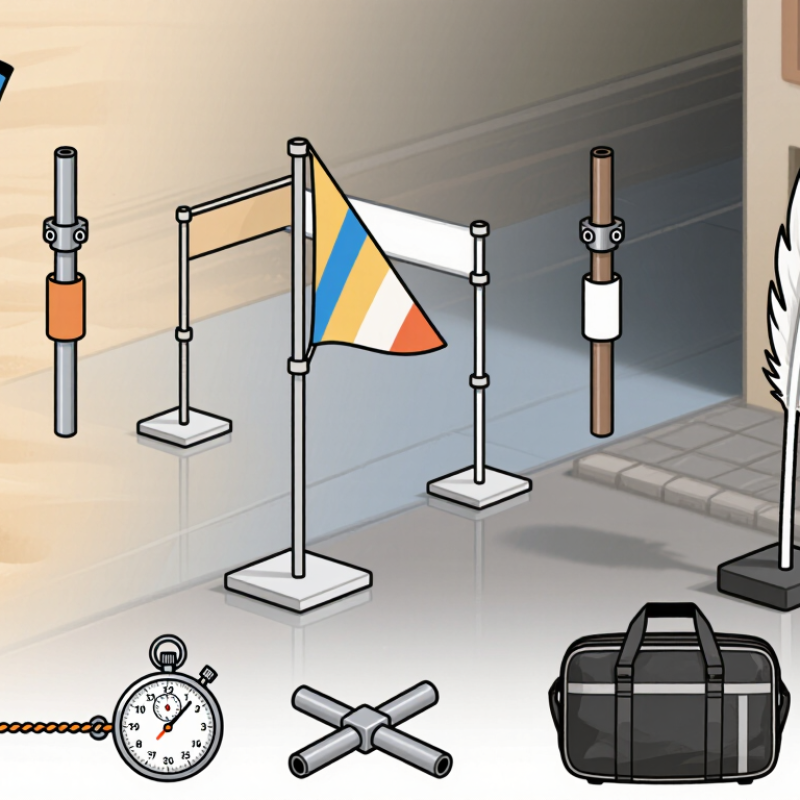
Advertising flag hardware is the support system that keeps a printed flag upright and visible. It usually includes a flexible pole, a base, connecting pieces, and a carry bag. Pole sections join to create the flag’s shape, while a sleeve or edge pocket holds the fabric against the pole. The base anchors the assembly and helps it resist movement.
The right base depends on the surface. A ground stake can suit soft soil, while a weighted plate offers support on hard pavement. Some bases rotate, allowing the flag to turn with changing wind direction. Small details matter. Check that pole joints fit snugly and that the base matches the pole’s connection. A loose joint can cause wobbling; a base that is too light may shift outdoors.
During setup, connect the pole sections in order, fit the fabric, and secure the pole to its base. Keep the flag taut, but do not force the fabric over the frame. That can strain seams. I still check each connection by hand before use; it is a simple step, though easy to skip. Hardware performance also depends on flag size, wind, and surface conditions. There is no single setup that works best everywhere.

In 2026, advertising flag hardware generally pairs a flexible pole with a base suited to the display surface. Cross bases work on level indoor floors and paved areas; add a compatible water or sand weight when breezes are likely. Ground spikes anchor flags in firm soil, while screw-style bases suit softer ground. Not every site accepts every base.
Tips: Match the pole to the flag’s sleeve shape and height, and check stated compatibility. Telescopic poles pack compactly and adjust quickly. Sectional fiberglass poles flex with airflow; aluminum sections feel stiffer. Test assembly before travel. Small parts go missing.
For temporary outdoor displays, water-fillable tanks or weighted plates can stabilize poles on hard surfaces, though their weight and footprint matter. Wheel-mounted bases may suit certain event locations, where access is safe and permitted. Choose a system for the expected conditions, not just its price. Inspect joints and clips for wear. A loose connector deserves attention, even when the flag still stands. There is no perfect all-purpose setup; the tidiest option may not be the steadiest.
The best hardware depends on the flag shape, installation surface, wind exposure, and how often the display will be moved. The options below describe common, unbranded systems; dimensions and compatibility vary by manufacturer.
| Base System | Suitable Surface | Typical Setup | Main Advantages | Limitations and Checks |
|---|---|---|---|---|
| Cross base with water bag | Flat, hard surfaces such as pavement, indoor floors, or event flooring | Folding metal cross feet; a water-fillable fabric bag adds ballast | Portable, folds for storage, and the bag can be filled on site | Needs a level surface; added ballast improves stability but does not make it suitable for every wind condition |
| Ground spike | Grass, soil, or other penetrable ground | Metal spike driven into the ground, often with a rotating bearing | Light to carry and quick to install; suitable for outdoor soft ground | Cannot be used on concrete or paving; soil firmness and buried utilities should be considered |
| Flat plate base | Level hard surfaces | Weighted metal plate with a socket or rotating fitting for the pole | Low profile and stable on a flat surface; no ground penetration required | Heavier to transport; plate weight and footprint should match the flag size and expected conditions |
| Auger screw base | Soil, turf, or sand that can accept a screw-in anchor | Helical metal ground screw, commonly paired with a rotating pole fitting | Can provide a firm anchor in suitable ground and is compact to carry | Installation depends on ground conditions; not suitable for hard paving or rocky ground |
| Vehicle tire base | Outdoor locations beside a parked vehicle | Flat bracket is positioned beneath a vehicle tire to hold the pole socket | Uses the vehicle’s weight as ballast and needs no ground penetration | Requires a safely parked vehicle and suitable tire placement; not an option for pedestrian-only sites |
| Wall or railing bracket | Suitable walls, fences, or railings | Fixed or clamp-on socket holds a compatible pole at an angle or upright | Can keep the display off the ground and save floor space | Must be securely fixed to an appropriate structure; check permitted mounting locations and pole angle |
| Pole System | Construction and Adjustment | Typical Uses | Advantages | Things to Check |
|---|---|---|---|---|
| Flexible fiberglass sectional pole | Joined fiberglass sections flex under airflow; sections assemble to a set configuration | Feather, teardrop, and other curved or tensioned flag shapes | Flex helps maintain the flag’s shape as it moves; sections pack down for transport | Match the pole shape and section length to the flag sleeve and base socket |
| Hybrid fiberglass and aluminum pole | Combines flexible fiberglass sections with more rigid aluminum sections | Flag kits requiring both controlled flex and firmer support | Balances flexibility with rigidity; often supplied as a multi-section assembly | Section order, connector type, and overall assembled height must match the flag system |
| Telescopic aluminum pole | Nested sections extend and lock at a selected height | Rectangular or sleeve-mounted flags and displays needing adjustable height | Height can be adjusted; retracts for storage and transport | Check locking mechanisms, maximum extension, and whether the pole is designed for the flag’s shape and wind exposure |
| Rigid sectional aluminum pole | Straight aluminum tubes connect end-to-end to form a fixed-height pole | Vertical flags, banners, or setups that use a straight pole sleeve | Simple construction and a stable, non-flexing profile | Requires compatible connectors and a suitable base; a rigid pole may transmit more force to the base in gusts |
Selection tip: Confirm the flag’s sleeve or pole-pocket design, assembled pole length, socket diameter, and base connection before ordering. For outdoor use, follow the hardware supplier’s wind and installation guidance, and take the display down when conditions exceed its recommended limits.
Flag stability begins with the pole, base, and connector—not the printed fabric alone. Aluminum poles resist corrosion and stay light, while fiberglass can flex under gusts. That flex helps, but repeated bending may fatigue joints. A weighted steel base can steady a display on hard floors; soft ground needs a properly sized stake. Small parts fail.
ASCE 7-22 expresses wind pressure through a velocity-squared relationship. Its simplified term, before site and exposure adjustments, is q = 0.00256V² psf when speed is measured in miles per hour. At 30 mph, that is about 2.3 psf; at 60 mph, about 9.2 psf. Double the wind speed, and the pressure term roughly quadruples. This is why a slim pole can still face substantial loads. Seams, pole sleeves, and locking fittings deserve attention alongside material choice. A loose connector can let a flag twist, concentrating stress near the base. Still, a heavier base is not automatically safer if its footprint is narrow or the surface is uneven. Match the hardware to the installation surface, expected gusts, and flag size, then inspect joints for play before use. The simplest-looking setup may need the most careful anchoring.
How base materials affect ballast weight—and why design matters for stability
Typical approximate material densities are shown in kg/L; actual values vary by grade and composition. For bases of equal volume, denser materials provide more mass. Stability also depends on base footprint, a low center of gravity, secure pole connections, and wind conditions—so density alone does not determine the best hardware.
What Is the Best Advertising Flag Hardware in 2026?
The best advertising flag hardware depends on where it will stand and what conditions it must handle. A feather flag beside a shop entrance needs a compact base that fits the pavement without blocking foot traffic. On grass, a ground spike can hold the pole, but rocky soil may make installation difficult. Measure the available space before choosing.
Wind and surface matter. For an exposed parking lot, a heavier cross base with a water-weighted ring can offer more stability on flat ground. It still needs monitoring in strong gusts. A spike suits softer ground, while a small indoor base works on clean floors with little airflow. Check that the pole and connectors match the flag’s sleeve or fitting. Small mismatches can cause frustrating delays.
Think about transport, too. Event crews often prefer folding bases and lightweight poles that fit in a vehicle. Fixed storefront displays can use sturdier hardware, even if assembly takes longer. Test it first. Set up the flag on the actual surface, then check for wobble and clearance. I would not judge stability from a product photo alone; that is an easy mistake to make. After a windy day, inspect joints, fasteners, and the base for movement or wear.
Start with the site, not the pole. A feather flag outside a shop needs a different base from one displayed on indoor carpet. Check the ground surface, expected setup time, flag shape, and how often staff will move it. On pavement, a weighted cross base may be practical; on suitable soil, a ground spike can hold the pole directly. Small details matter.
OAAA reported that U.S. out-of-home advertising revenue reached $9.1 billion in 2023. That figure describes the wider advertising market, not flag-hardware performance, but it shows why dependable displays matter to businesses.
Wind exposure should influence every outdoor choice. NOAA’s 2023 disaster report recorded 28 U.S. weather and climate events that each caused at least $1 billion in damage. This is a planning prompt, not a wind rating for any flag. Ask suppliers for documented operating limits, base compatibility, and replacement-part availability. Match the hardware to the flag’s size, and follow its setup guidance.
I would check those details before choosing a taller pole. A high display can catch more wind, and a heavier base may be awkward to transport. For frequent use, compare packed weight, assembly time, and spare-pole availability.
Not just height. In practice, the easiest kit to carry may not feel stable on a gusty corner. That trade-off deserves a real site test.
| Cookie | Duration | Description |
|---|---|---|
| cookielawinfo-checkbox-analytics | 11 months | This cookie is set by GDPR Cookie Consent plugin. The cookie is used to store the user consent for the cookies in the category "Analytics". |
| cookielawinfo-checkbox-functional | 11 months | The cookie is set by GDPR cookie consent to record the user consent for the cookies in the category "Functional". |
| cookielawinfo-checkbox-necessary | 11 months | This cookie is set by GDPR Cookie Consent plugin. The cookies is used to store the user consent for the cookies in the category "Necessary". |
| cookielawinfo-checkbox-others | 11 months | This cookie is set by GDPR Cookie Consent plugin. The cookie is used to store the user consent for the cookies in the category "Other. |
| cookielawinfo-checkbox-performance | 11 months | This cookie is set by GDPR Cookie Consent plugin. The cookie is used to store the user consent for the cookies in the category "Performance". |
| viewed_cookie_policy | 11 months | The cookie is set by the GDPR Cookie Consent plugin and is used to store whether or not user has consented to the use of cookies. It does not store any personal data. |
| Key Principles | Criteria |
| Environment |
|
| CSR Policies and Reporting |
|
| Social Investment Programmes |
|
| Key Principles | Criteria |
| Quality of Product |
|
| Quality of Factory |
|
| Quality of Management |
|
| Key Principles | Criteria |
| Monitoring and Control |
|
| Management |
|
| Key Principles | Criteria |
| Global Presence |
|
| Logistical Assets |
|
| Terminal Handling |
|
| Key Principles | Criteria |
|
Tapping and Field Latex |
|
|
Concentrated Latex Processing, Handling & Storage and Shipping |
|
|
Laboratory & Chemical Handling |
|
|
EHS Management System |
|
| Key Principles | Criteria |
|
Monitoring and Mitigating Key Impacts |
|
|
Social Responsibility |
|
|
Social Investment |
|
| Key Principles | Criteria |
|
Security Controls |
|
|
Security Certification |
|
| Key Principles | Criteria |
|
Quality of Raw Material |
|
|
Quality of Process |
|
|
Quality of Management |
|
| Key Principles | Criteria |
| Certified Team |
|
| Technical Expertise |
|
| Key Principles | Criteria |
| International Standards and Certification |
|
| Customised Products |
|
| Testing |
|
| Key Principles | Criteria |
| Security Controls |
|
| Security Certification |
|