

Choosing Durable Pvc Urine Bag Film requires more than checking thickness or price. The film must remain flexible during storage, transport, and daily handling. It should resist punctures, tearing, plasticizer migration, and leakage around heat-sealed seams. Clear visibility also matters. A nurse should see urine color, sediment, and fill level without repeatedly moving the bag.
Industry reports from Grand View Research and Fortune Business Insights describe steady demand for urinary drainage bags, supported by hospital care, home treatment, and aging populations. These reports also highlight performance, infection-control expectations, and manufacturing consistency as important purchasing factors. However, market growth does not prove that every PVC film is clinically suitable. That assumption deserves criticism.
Dr. Sanjay Saint, a recognized catheter-safety researcher, has emphasized, “The best catheter is no catheter.” His statement reminds manufacturers to consider the complete drainage system, not only the film. When a catheter is necessary, dependable materials can reduce avoidable handling problems. Still, film selection should follow documented testing, supplier audits, and intended-use evaluation.
Relevant checks include ISO 10993 biological evaluation, ISO 13485 quality systems, and ASTM methods for tensile strength, elongation, and tear resistance. A practical test should examine a sealed bag after bending, hanging, filling, and simulated transport. Weak seams often reveal themselves here.
Durable Pvc Urine Bag Film should therefore be judged by evidence, not attractive samples. Specifications can look precise. Real performance may differ. Manufacturers should compare batch records, migration data, weld strength, and aging results before approval.
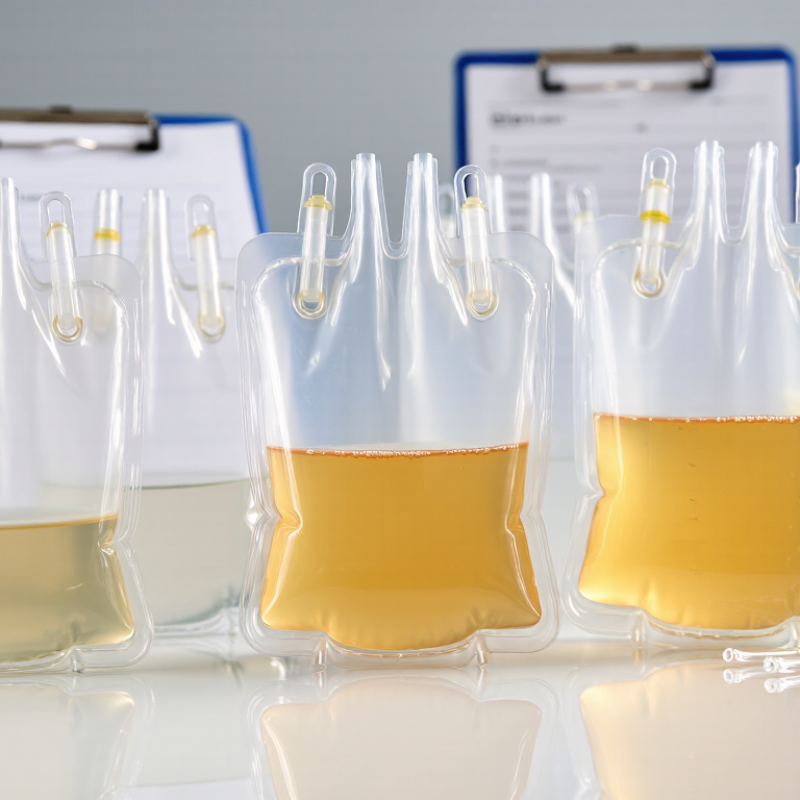
PVC urine bag film must balance flexibility, strength, clarity, and patient safety. A suitable film should remain soft during handling without becoming weak at low temperatures. Its surface should feel smooth, with no sharp edges, pinholes, or visible particles.
Medical-grade PVC requires documented biocompatibility evaluation, including attention to plasticizers and extractable substances. Manufacturers should assess relevant ISO 10993 tests according to the product’s contact type and duration. The film must also support reliable heat sealing. A weak seal can leak around the outlet, tubing, or hanger area.
Durability needs practical testing, not only supplier claims. In production trials, fill bags with liquid, apply pressure, and inspect welded seams after repeated handling. Check drop resistance, puncture strength, elongation, and dimensional stability. Clarity matters too. Nurses need to observe urine color, sediment, and volume through the film. A slight haze may hide useful clinical details.
Sterilization compatibility deserves careful review. PVC can change after exposure to heat, radiation, or chemical processes. Test the finished bag, not only the raw film. Storage conditions also matter because excessive heat may affect flexibility and seal performance. No film is perfect. I would question results that lack batch traceability, aging data, or real-use simulation. A dependable selection combines technical documents, laboratory evidence, and feedback from medical staff.

Choosing durable PVC urine bag film requires more than checking thickness. ISO 8669-1 identifies leakage, tensile performance, and connection security as essential test areas for urine collection bags. In practice, measure puncture force, tear propagation, and seal strength separately. A 0.25–0.40 mm film may feel robust, but thickness alone cannot predict failure.
Flexibility matters during bed transfers and overnight movement. ASTM D882 tensile testing can compare elongation before cracking or permanent deformation. Film should bend around a filled bag without whitening, sharp creases, or stress marks. ASTM D1709-style impact testing adds useful evidence, especially near ports and welded seams. Watch the weak points. A high puncture result means little if the heat seal splits under modest loading.
Reports from Smithers and healthcare packaging quality reviews repeatedly emphasize seal integrity and material consistency as major risk controls. Ask suppliers for batch-level results, not one attractive laboratory sheet. Record thickness variation, elongation, puncture force, and seal strength across multiple samples. A practical screening plan might test empty and fluid-filled bags at room temperature and after cold conditioning. Our first assumption is often wrong: softer PVC may improve handling, yet excessive plasticizer migration can change feel and strength over time. Review ISO 8669 results, ASTM methods, and aging data together. Do not rely on appearance.
Reference ranges for evaluating tensile strength, flexibility, tear resistance, and puncture resistance
Flexible PVC medical films commonly show tensile strength of approximately 10–25 MPa, elongation at break of 200–450%, tear strength of 30–70 kN/m, and puncture force of 8–20 N, depending on film thickness, plasticizer formulation, and test method. For urine bag applications, select film that balances high puncture and tear resistance with sufficient flexibility for folding, welding, and handling. These are representative engineering ranges rather than regulatory pass/fail limits; final acceptance should be based on validated testing and supplier certificates.
Choosing durable PVC urine bag film requires more than checking thickness or visual clarity. Biocompatibility comes first. Request testing aligned with ISO 10993-1, including cytotoxicity, sensitization, and irritation assessments. Chemical characterization under ISO 10993-18 can reveal extractables and leachables. Plasticizer identity matters, especially when urine contacts the film for extended periods. A clear film may still be chemically unsuitable.
Medical-grade claims should be supported by evidence, not wording alone. Check ISO 8669-2 requirements for urine collection bags, along with tensile strength, tear resistance, puncture resistance, and seam integrity. Ask for batch-specific certificates, material composition, sterilization compatibility, and change-control records. The WHO Global Report on Infection Prevention and Control (2022) reports healthcare-associated infections affect about 7 in 100 patients in high-income countries and 15 in 100 patients in low- and middle-income countries. Film safety cannot prevent every infection, but weak materials can create avoidable leakage and handling risks.
I once treated thickness as durability. That was an incomplete shortcut.
Tips: Compare film samples after simulated urine exposure and storage. Inspect odor, discoloration, brittleness, and seal strength. Request independent laboratory reports, not only supplier declarations. Medical-grade is not a universal guarantee. Verify the exact standard, test method, and production lot before approval.
How to Choose Durable PVC Urine Bag Film for Medical Use?
Selecting PVC film for a urine bag requires more than checking thickness. In practice, barrier performance helps control moisture loss, odor migration, and contamination during storage and use. Ask suppliers for measured water vapor transmission, chemical resistance, and aging data. Results should cover intended sterilization exposure and realistic temperature changes. A thicker film is not automatically better. It may become stiff and uncomfortable.
Sealing performance deserves close attention. The film must form consistent heat seals across its approved processing window. Check seal strength after aging, folding, and contact with urine-like fluids. Burst tests should include corners, ports, and tubing connections, where failures often begin. Look for smooth seal lines without channels or burnt edges. I would request production samples, not only laboratory coupons. Small differences matter. A film can pass one test and still seal poorly on a fast manufacturing line.
Transparency supports safer handling. Clear, low-haze film helps users read graduations, observe color changes, and notice sediment or leaks. It should remain clear after sterilization and prolonged fluid contact. Excessive gloss can create glare, however. Not always obvious. Evaluate visibility under ward lighting, not only bright inspection lamps. Reliable selection combines documented testing, traceable batch records, and practical trials with the final bag design. Some assumptions may need revisiting after transport vibration and repeated bending.
| Performance Area | Key Metric | Typical Screening Range for Flexible Medical PVC Film | Suggested Test Method | Selection Consideration |
|---|---|---|---|---|
| Moisture Barrier | Water Vapor Transmission Rate (WVTR) | Approximately 1–8 g/m²/day for 200–300 μm flexible PVC film, depending on plasticizer, thickness, and test conditions | ASTM F1249 or ASTM E96; report temperature and relative humidity | Lower WVTR helps limit evaporation, concentration changes, and moisture loss during storage. |
| Oxygen Barrier | Oxygen Transmission Rate (OTR) | Approximately 300–2,000 cm³/m²/day for uncoated flexible PVC at 23°C and 50% RH | ASTM D3985 or ISO 15105-2 | For routine urine collection, moderate oxygen barrier is generally adequate; lower OTR may be preferred for longer storage or odor-control designs. |
| Film Thickness | Nominal thickness and thickness uniformity | Common construction range: 150–400 μm; target thickness tolerance often within ±5–10% | ISO 4593 or ASTM D6988 | Greater thickness usually improves puncture resistance and handling strength but can reduce flexibility and transparency. |
| Tensile Strength | Machine-direction and cross-direction tensile strength | Approximately 15–25 MPa for plasticized flexible PVC film | ASTM D882 or ISO 527-3 | Check both directions because extrusion orientation can create unequal strength and affect bag durability. |
| Elongation | Elongation at break | Approximately 200–400% for soft, plasticized PVC film | ASTM D882 or ISO 527-3 | Higher elongation supports flexing and impact absorption, but excessive softness may make handling and sealing less consistent. |
| Puncture Resistance | Peak puncture force | Common development target: at least 10–20 N for 200–300 μm film, subject to probe geometry and test setup | ASTM F1306 or ISO 7765-1 | Use a defined target based on transport, bedside handling, tubing components, and expected contact with sharp edges. |
| Heat-Seal Strength | Seal strength after conditioning | Typical development target: ≥15 N/15 mm for peelable or permanent medical pouch-style seals; final target depends on seal design | ASTM F88/F88M or ISO 11607-1/-2 | Evaluate seal strength across the operating window, not only at the optimum temperature and pressure. |
| Seal Process Window | Sealing temperature and dwell-time tolerance | Typical heat-seal development window: approximately 120–180°C, depending on formulation, tooling, pressure, and line speed | ASTM F2029 for heat-seal initiation studies; confirm with production equipment | A wider process window reduces weak seals, burn-through, channel leaks, and production variation. |
| Leak Integrity | Leak rate or pass/fail under pressure and vacuum | A practical design requirement is zero visible leakage during validated pressure, vacuum, and flexing tests | ASTM F2096, ASTM D3078, or an internally validated pressure-decay method | Test complete bags, including ports, tubing connections, seals, and corners; film-only testing is insufficient. |
| Transparency | Total light transmittance | Common clear-film target: ≥85% total transmittance | ASTM D1003 or ISO 13468-1 | High transmittance supports visual monitoring of fill level, color, sediment, and contamination. |
| Haze | Percentage of diffused transmitted light | Preferred clear-film target: ≤10%; lower haze provides a sharper view of contents | ASTM D1003 | Haze can increase after sterilization, aging, printing, or contact with incompatible additives, so test the finished product. |
| Low-Temperature Flexibility | Brittleness or cracking temperature | A suitable formulation should remain flexible at the validated transport and storage minimum; many plasticized PVC grades are designed for temperatures below 0°C | ASTM D1790 or ISO 8570 | Important for cold-chain transport, unheated storage, and handling immediately after delivery. |
| Biocompatibility and Extractables | Material safety and chemical compatibility | Must meet the applicable medical-device biological evaluation and chemical characterization requirements for the intended contact duration | ISO 10993 series; ISO 10993-18 and ISO 10993-17 where applicable | Confirm the complete formulation, including plasticizers, stabilizers, colorants, adhesives, inks, and processing residues. |
Note: The numerical ranges are representative engineering screening values for flexible medical PVC constructions, not guaranteed specifications. Final acceptance criteria should be established using the selected film thickness, bag geometry, sealing equipment, sterilization method, storage conditions, and applicable regulatory requirements.
How to Choose Durable PVC Urine Bag Film for Medical Use?
A reliable PVC film supplier should understand urinary drainage products, not only sell plastic rolls. Ask for documented experience with medical tubing, bag forming, heat sealing, and sterilization conditions. The supplier should provide consistent resin information, plasticizer details, biocompatibility data, and lot traceability. Clear records matter.
Request samples from several production lots. Check film thickness, tensile strength, elongation, tear resistance, and seal strength. Test the film after aging and sterilization, because a flexible film may become brittle later. Inspect the surface under bright light. Small gels, pinholes, wrinkles, or uneven thickness can weaken a finished urine bag. A perfect-looking roll can still fail.
Quality control should continue during manufacturing. Measure thickness across the roll, verify sealing temperature, and perform leak tests on finished bags. Use simulated filling and hanging tests to examine stress around ports, corners, and welded seams. Review certificates, but do not rely on paperwork alone. An independent laboratory can confirm extractables, migration, and biological safety when required by the intended market. Supplier audits should examine calibration records, clean handling, nonconforming-product controls, and employee training. No checklist is perfect. Our own testing can miss failures when samples are too small or storage conditions are unrealistic. Record those weaknesses, revise the plan, and keep every batch traceable from raw material to shipment.
| Cookie | Duration | Description |
|---|---|---|
| cookielawinfo-checkbox-analytics | 11 months | This cookie is set by GDPR Cookie Consent plugin. The cookie is used to store the user consent for the cookies in the category "Analytics". |
| cookielawinfo-checkbox-functional | 11 months | The cookie is set by GDPR cookie consent to record the user consent for the cookies in the category "Functional". |
| cookielawinfo-checkbox-necessary | 11 months | This cookie is set by GDPR Cookie Consent plugin. The cookies is used to store the user consent for the cookies in the category "Necessary". |
| cookielawinfo-checkbox-others | 11 months | This cookie is set by GDPR Cookie Consent plugin. The cookie is used to store the user consent for the cookies in the category "Other. |
| cookielawinfo-checkbox-performance | 11 months | This cookie is set by GDPR Cookie Consent plugin. The cookie is used to store the user consent for the cookies in the category "Performance". |
| viewed_cookie_policy | 11 months | The cookie is set by the GDPR Cookie Consent plugin and is used to store whether or not user has consented to the use of cookies. It does not store any personal data. |
| Key Principles | Criteria |
| Environment |
|
| CSR Policies and Reporting |
|
| Social Investment Programmes |
|
| Key Principles | Criteria |
| Quality of Product |
|
| Quality of Factory |
|
| Quality of Management |
|
| Key Principles | Criteria |
| Monitoring and Control |
|
| Management |
|
| Key Principles | Criteria |
| Global Presence |
|
| Logistical Assets |
|
| Terminal Handling |
|
| Key Principles | Criteria |
|
Tapping and Field Latex |
|
|
Concentrated Latex Processing, Handling & Storage and Shipping |
|
|
Laboratory & Chemical Handling |
|
|
EHS Management System |
|
| Key Principles | Criteria |
|
Monitoring and Mitigating Key Impacts |
|
|
Social Responsibility |
|
|
Social Investment |
|
| Key Principles | Criteria |
|
Security Controls |
|
|
Security Certification |
|
| Key Principles | Criteria |
|
Quality of Raw Material |
|
|
Quality of Process |
|
|
Quality of Management |
|
| Key Principles | Criteria |
| Certified Team |
|
| Technical Expertise |
|
| Key Principles | Criteria |
| International Standards and Certification |
|
| Customised Products |
|
| Testing |
|
| Key Principles | Criteria |
| Security Controls |
|
| Security Certification |
|