How to Vulcanize Rubber for Industrial Applications?
Vulcanizing Rubber transforms a soft compound into a stronger, more heat-resistant material through controlled crosslinking. In industrial production, that change affects service life, flexibility, sealing performance, and resistance to repeated loading. The International Rubber Study Group’s World Rubber Industry Outlook 2024 places global rubber demand at roughly 30 million tonnes annually. That scale matters. Small variations in formulation, temperature, or cure time can influence products made for vehicles, factories, and infrastructure.
A reliable process starts with the compound, not just the press. Technicians consider polymer type, sulfur or alternative curing systems, accelerators, fillers, and the part’s intended working conditions. They then establish a practical cure window through testing and production trials. ASTM D5289 provides a recognized method for measuring rubber vulcanization characteristics with a rotorless cure meter, including changes in torque over time. These measurements help engineers assess cure behavior; they do not replace checks on the finished component. That distinction is easy to overlook.
This guide explains how to select materials, set curing conditions, monitor quality, and address common defects in industrial applications. Actual results depend on equipment, geometry, and compound design, so a published recipe is only a starting point. Even careful processes need review.
Selecting Rubber Compounds and Vulcanizing Agents
For industrial vulcanization, select the rubber compound from the service conditions, not from price alone. An EPDM compound often suits outdoor parts exposed to heat, water, and ozone. NBR is commonly considered for oil contact, while natural rubber can provide strong resilience and flex fatigue resistance. Check the actual fluid, temperature range, and expected compression before choosing. Small details matter.
The curing agent must match both the polymer and the part’s performance needs. Sulfur systems are widely used with unsaturated rubbers and can support flexible, fatigue-resistant parts. Peroxide systems may offer better heat-aging performance in suitable compounds, though tear strength or flex behavior may need careful checking. Coagents and accelerators also affect cure speed and final properties. There is no universal recipe.
In practice, compare compound data with test results from the intended process. A cure rheometer can help identify scorch time and optimum cure, but thick sections may heat unevenly. That is easy to miss. Review hardness, tensile strength, compression set, and aging after curing, rather than relying on a single reading. If a part cracks near a sharp corner, the issue may be compound choice, cure conditions, or the mold design; changing the agent alone may not fix it.
Preparing and Mixing the Rubber Compound
Preparing a reliable rubber compound starts with controlled inputs.
Check polymer grade, filler moisture, oil viscosity, and curative weights before charging the mixer. ASTM D3182 provides a standard practice for mixing rubber compounds and preparing test sheets; it is a useful benchmark, not a substitute for plant-specific validation. Record batch mass, rotor speed, mixing time, and discharge temperature. Small changes matter. Add polymer first, then fillers and process oil in measured stages, allowing each addition to disperse before the next. On a two-roll mill, watch the band closely: dry pockets and uneven edges can signal poor incorporation.
Add sulfur and accelerators late, after the compound has cooled sufficiently for the formulation. This reduces the risk of premature curing, or scorch, during mixing. Measure temperature rather than relying on touch.
The International Rubber Study Group’s World Rubber Industry Outlook (April 2024) projected global rubber demand to rise 2.3% to 30.4 million tonnes in 2024, underscoring the scale of consistent production needs. That market figure does not prescribe a mixing recipe. Each formulation still needs trial batches, dispersion checks, and cure testing.
A batch log can reveal drift, though operators sometimes record settings without noting unusual material behavior. That omission deserves attention.
Shaping the Compound into Industrial Products
Before vulcanization, the compound must be shaped to match the product and its working conditions. Compression molding suits thick, simple parts, while injection molding can fill detailed cavities with repeatable dimensions. Transfer molding helps when inserts or complex internal features are involved. The right choice depends on compound flow, part geometry, and production volume—not just machine speed.
The International Rubber Study Group’s 2024 World Rubber Industry Outlook puts global rubber demand at roughly 30 million tonnes annually, underscoring the scale of material processing across industries. On the factory floor, operators commonly weigh and preform uncured rubber, then place it into a heated mold. Venting matters: trapped air can leave voids, and excess material can form flash along the parting line.
Small details matter. Cure time and temperature should be set using compound-specific rheometer data and validated on actual parts; a thick seal may cure differently from a thin diaphragm. Not every batch. Changes in filler, moisture, or preform placement can shift flow and cure behavior. Inspect dimensions and surface defects after demolding, and record the settings. A process can look stable while hiding variation. That deserves a second check.
Applying Heat and Pressure for Vulcanization
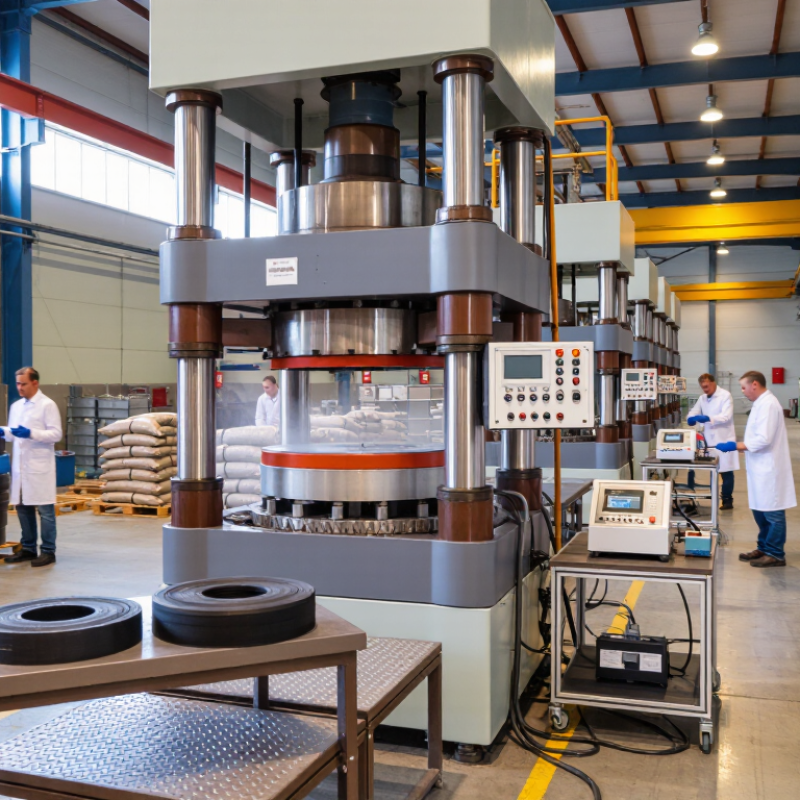
Vulcanization turns rubber into a more durable material by creating links between its polymer chains. In industrial production, heat activates the curing system, while pressure helps the compound fill the mold and maintain contact with its surfaces. The correct settings depend on the rubber formulation, part thickness, and mold design. There is no reliable universal cure time. A thick gasket, for example, may heat more slowly at its center than at its edges.
Use calibrated temperature sensors and verify that the press applies even pressure across the mold. Trapped air, uneven loading, or a cold mold can leave weak spots and rough surfaces. Set the cure cycle according to compound data and production trials, then inspect sample parts for incomplete curing, scorching, or dimensional changes. Keep the process record. It helps identify drift between batches. One detail is easy to miss: a cycle that works for a small test piece may not suit a larger production part. Recheck it after changes.
Tips: Preheat the mold evenly. Keep mating surfaces clean. Record temperature, pressure, and cure time for each trial. If results vary, review the setup before simply extending the cycle.
Testing Cured Rubber for Quality and Performance
How to Vulcanize Rubber for Industrial Applications?
Testing Cured Rubber for Quality and Performance
A cured part can look flawless and still fail under load. Test specimens from the same batch, not just a convenient sample. ASTM D412 measures tensile strength and elongation; ASTM D2240 measures hardness. These methods make results comparable when specimen shape, conditioning, and test speed stay controlled.
A lot report might record 16.8 MPa tensile strength, 420% elongation, and 68 Shore A hardness. These are illustrative readings, not universal acceptance limits. Compare them with the part specification and previous production data. A sharp drop in elongation can signal over-curing or material variation. Check the cure record, too. Small temperature differences matter.
Heat and compression expose weaknesses that a quick pull test may miss. ISO 188 describes accelerated heat-aging procedures, while ASTM D395 covers compression set. Record values before and after aging, including specimen dimensions and exposure conditions. For a seal, retained thickness after compression is more useful than appearance alone. One weak spot: rushed sampling can hide variation across a large mold. Test edge and center cavities when practical, and document failures without quietly retesting them away.