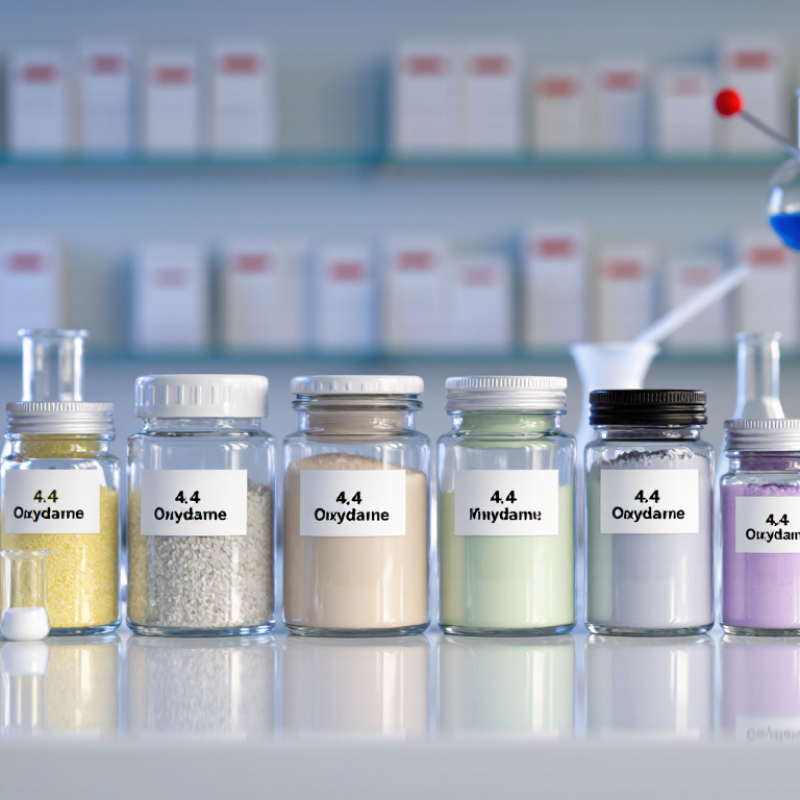
| 1 | Standard 4,4′-Oxydianiline | Usually around 98–99% | CAS RN 101-80-4; molecular formula C12H12N2O; molecular weight 200.24 g/mol | White to off-white crystalline solid; melting range commonly reported at approximately 188–192 °C | General-purpose intermediate and aromatic diamine feedstock |
| 2 | High-Purity 4,4′-Oxydianiline | Typically ≥99.5% | Same chemical identity: 4,4′-oxydianiline, also known as 4,4′-diaminodiphenyl ether | Reduced levels of unreacted intermediates and related aromatic impurities; white crystalline material when properly stored | Precision polymer synthesis and applications requiring consistent stoichiometry |
| 3 | Polymer-Grade 4,4′-Oxydianiline | Often specified at ≥99%; exact limit depends on polymer process | A bifunctional aromatic diamine containing two primary amino groups and one ether linkage | Controlled purity, moisture, color, and residue are important for repeatable polymer molecular weight and film quality | Polyimides, polyamide-imides, epoxy curing systems, and other high-performance polymers |
| 4 | Low-Moisture 4,4′-Oxydianiline | Purity commonly ≥99%; moisture limit is separately agreed | C12H12N2O; hygroscopic exposure should be minimized during handling and storage | Lower water content supports accurate diamine-to-dianhydride or other reactive-group ratios | Moisture-sensitive polymerization and controlled laboratory or production processes |
| 5 | Low-Color 4,4′-Oxydianiline | Usually high-purity material; color limit is application-specific | Same CAS RN 101-80-4 and molecular formula C12H12N2O | Selected for low visible coloration and controlled oxidation-related discoloration during processing | Light-colored polyimide films, coatings, composites, and specialty resin systems |
| 6 | Fine-Powder 4,4′-Oxydianiline | Typically 98–99.5%, depending on the specification | A crystalline aromatic diamine supplied as a dry solid powder | Smaller particle size can improve dispersion and dissolution rate; particle-size limits must be confirmed by test method | Laboratory batching, solution preparation, and processes requiring rapid solid-liquid contact |
| 7 | Controlled-Particle-Size 4,4′-Oxydianiline | Commonly ≥99%; particle-size distribution is separately defined | 4,4′-Oxydianiline with the same molecular structure and CAS RN 101-80-4 | Specified by sieve fraction, D-values, or distribution range rather than by a new chemical identity | Automated feeding, dispersion control, and scale-up operations |
| 8 | Low-Residue 4,4′-Oxydianiline | Often ≥99%; ash, insoluble matter, and residue limits are separately specified | Organic aromatic diamine; non-volatile inorganic residue is controlled as a quality attribute | Lower insoluble or inorganic residue can help reduce defects in transparent films and precision coatings | High-quality polymer films, optical materials, and contamination-sensitive formulations |
| 9 | Analytical or Research-Grade 4,4′-Oxydianiline | Purity and impurity profile are stated for the specific lot | Reference identity: CAS RN 101-80-4; C12H12N2O; 4,4′-diaminodiphenyl ether | Traceability, analytical method, lot documentation, and small-quantity packaging are emphasized | Method development, reference testing, formulation screening, and academic research |
| 10 | Industrial Bulk 4,4′-Oxydianiline | Commonly around 98–99% for general industrial use | Same molecular substance: 4,4′-oxydianiline, molecular weight 200.24 g/mol | Bulk purchasing focuses on lot consistency, packaging integrity, moisture protection, transport classification, and documentation | Large-scale resin, polymer, coating, adhesive, and specialty-material production |