Why Is Chemical Control Important for Downy Mildew?
Downy mildew can spread quickly when damp leaves and mild temperatures create favorable conditions. Pale, angular marks may appear on the upper leaf surface; gray or purple growth can develop underneath. By then, nearby plants may already be at risk. That is why Downy Mildew Chemical Control matters: it can help protect healthy tissue and limit crop losses when used as part of a timely, integrated plan.
Michigan State University plant pathologist Mary Hausbeck has conducted extensive research on cucurbit downy mildew. A practical paraphrase of her research-based guidance—not a verbatim quotation—is: “Timely, well-planned protection matters more than waiting for visible damage.” The point is important. Many downy mildew pathogens are oomycetes, not true fungi, so product choice and application timing must fit the crop, pathogen, and local conditions.
Chemical control is not a cure-all. Growers need to monitor forecasts and field symptoms, follow product labels, and rotate approved products with different modes of action to help manage resistance. Coverage matters. Missed leaf undersides can leave vulnerable tissue exposed. So can rain, new growth, or a spray applied too late. A useful control plan also includes resistant varieties, airflow, and careful irrigation where practical. No field plan is perfect; weather can change overnight. This introduction examines why chemical control is important, when it can help, and how to use it responsibly alongside other safeguards.
Understanding Downy Mildew and Its Effects on Crops
Why Is Chemical Control Important for Downy Mildew?
Understanding Downy Mildew and Its Effects on Crops
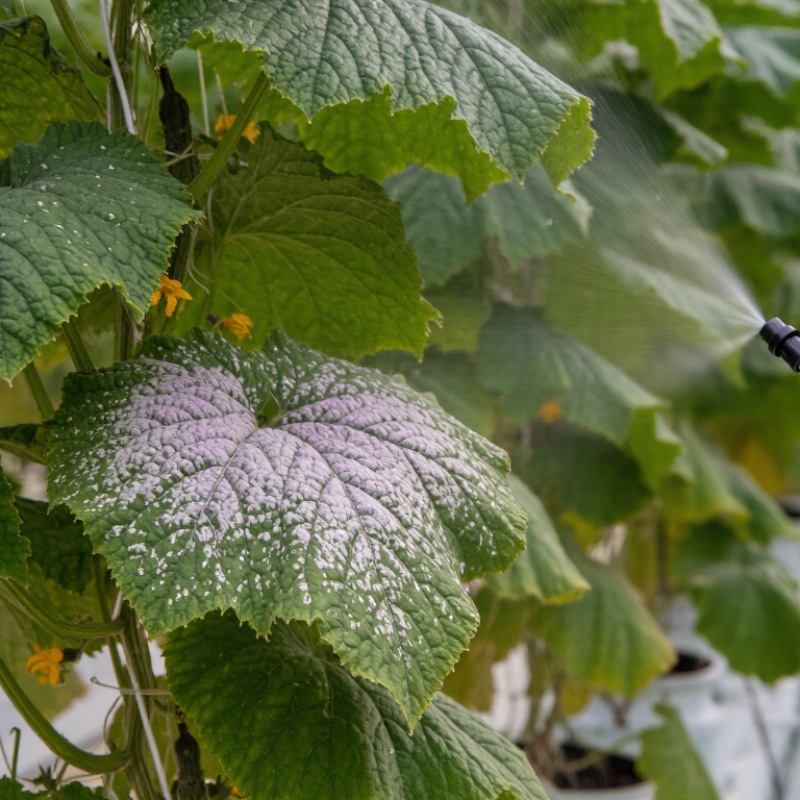
Downy mildew is caused by oomycetes, not true fungi. It affects crops such as cucumbers, melons, grapes, and leafy vegetables. On cucumber leaves, infection may appear as angular yellow patches, with gray-purple growth underneath in damp conditions. Lesions can merge, leaves die early, and fruit may remain small or fail to mature. The canopy can look healthy one week and battered the next.
Moisture matters. Spores spread through air and water, and extended leaf wetness can help infections take hold. Cornell Cooperative Extension’s cucurbit disease guidance describes downy mildew as a fast-moving threat that can require timely management. The broader stakes are substantial: FAO’s 2019 assessment estimates that plant pests and diseases cause annual losses of up to 40% of global food crops. That figure covers many threats; it is not a downy-mildew-specific estimate.
Chemical control can help protect new growth when disease risk is high, but it works best alongside scouting, resistant varieties, and practices that reduce lingering moisture. Timing and product choice matter, and local extension guidance should inform decisions. Field scouting is not perfect. Early symptoms can be easy to miss, especially after rain, when leaves are already marked by soil or other damage.
How Downy Mildew Spreads and Persists
Downy mildew spreads efficiently because its spores travel on air currents and settle on wet leaves. In grapevines, the pathogen can also persist through winter as durable oospores in fallen leaves. Rain then helps release and move spores onto young growth. The cycle can restart before pale, angular lesions are easy to spot.
UC Integrated Pest Management’s grape guidance describes a practical “three tens” warning: shoots near 10 centimetres, temperatures above 10°C, and roughly 10 millimetres of rain within 24 hours. These conditions signal infection risk, not certainty. Local weather and leaf wetness still matter. A forecast is useful, but never perfect.
Once infection takes hold, affected leaf undersides may develop a downy, pale coating. Spores from these lesions can spread during humid nights and wet periods, creating repeated infection cycles. This is why chemical protection often needs to precede visible damage, with timing guided by crop stage and weather. Waiting for obvious symptoms can leave healthy-looking leaves already exposed. Not every season follows the textbook; that is precisely where monitoring earns its place.
Why Chemical Control Is Important for Managing Outbreaks
Why Is Chemical Control Important for Downy Mildew?
Why Chemical Control Is Important for Managing Outbreaks
Downy mildew can spread quickly in cool, damp conditions. Yellow patches on leaf tops may appear with fuzzy growth underneath. During an outbreak, an appropriate fungicide can help slow new infections and protect healthy growth. It will not restore leaves already damaged. Act promptly, but confirm the diagnosis: other problems can create similar spots.
Chemical control works best alongside sanitation and careful watering. Product choice depends on the crop, disease pressure, and local guidance. Some fungicides mainly protect uninfected tissue; others may offer limited activity after infection. Use only products labeled for the crop and disease, and follow label directions. Rotate products with different modes of action when advised, since repeated use can encourage resistance. Coverage matters, too. Dense foliage can leave untreated surfaces.
Tips: Check leaf undersides and nearby plants often. Remove badly affected material where practical, improve airflow, and water at the base. Keep notes on weather and symptoms; patterns can help guide timing. Spraying is not a guarantee, especially after prolonged wet weather.
How Fungicides Suppress Downy Mildew
Why Is Chemical Control Important for Downy Mildew?
How Fungicides Suppress Downy Mildew
Downy mildew can spread quickly when leaves stay wet and air remains humid. Despite its name, it is caused by oomycetes, not true fungi, so not every fungicide works against it. A suitable fungicide can protect healthy leaf tissue by disrupting infection or limiting the pathogen’s growth. Most products work best before symptoms appear or early in an outbreak. They rarely restore leaves already marked with yellow patches or fuzzy growth beneath them.
Timing matters. Apply only products labeled for the crop and disease, and follow the label’s directions, including application intervals and protective measures. Good coverage is important: spray must reach susceptible leaves, including their undersides when the label allows. Rain, new plant growth, and continued humid weather can reduce protection. Repeated use of the same mode of action may encourage resistance, so rotation should follow label guidance and local agricultural recommendations. A spray alone may not solve the problem; airflow, careful watering, and removing heavily affected plants can also help.
Tips: Check leaf undersides after damp nights. Keep notes on weather, symptoms, and spray dates; memory gets fuzzy. Avoid spraying on a fixed calendar without checking conditions, and seek local extension advice when diagnosis is uncertain.
Why Is Chemical Control Important for Downy Mildew? — How Fungicides Suppress Downy Mildew
| Dimension | How Chemical Control Helps | Practical Consideration |
| Disease biology | Downy mildew is caused by oomycetes—organisms related to, but distinct from, true fungi. Many produce spores that can spread and infect plants rapidly when conditions are favorable. | Choose products labeled for the specific crop and downy mildew pathogen; products effective against other fungal diseases may not control oomycetes. |
| Protective suppression | Protectant fungicides can leave a treated surface that interferes with spore germination or early infection. | Coverage of susceptible plant surfaces is important. New growth and rain or irrigation may reduce protection, so follow label directions for reapplication. |
| Activity after infection | Some fungicides have limited post-infection activity and may slow early disease development inside plant tissue. | They generally cannot restore tissue already damaged by disease. Apply at the timing specified on the product label rather than relying on late treatment. |
| Risk-based timing | Well-timed applications can reduce infection and sporulation when susceptible crops face conducive conditions, such as leaf wetness and suitable temperatures. | Use local disease forecasts, field scouting, crop growth stage, and label intervals to guide decisions. Weather and risk patterns differ by crop and region. |
| Different modes of action | Fungicides act in different ways. For example, copper compounds have multi-site activity, while products containing metalaxyl or mefenoxam have a more specific mode of action. | Active ingredients and permitted uses vary by country and crop. Check the current local label and FRAC group information before use. |
| Resistance management | Repeated use of a single-site mode of action can select for less-sensitive pathogen populations and reduce future control. | Rotate or mix modes of action only as permitted by the label and resistance-management guidance. Do not exceed application limits. |
| Integrated disease management | Chemical control can complement resistant varieties, crop rotation where appropriate, removal of infected residues, good airflow, and careful irrigation. | Fungicides work best as one part of an integrated program, not as a substitute for monitoring and sound crop management. |
| Safe and effective use | Correct application helps achieve the intended level of suppression while reducing unnecessary exposure and off-target movement. | Follow the product label, including protective equipment, application rate, pre-harvest interval, re-entry interval, and environmental precautions. |
Note: Fungicide performance depends on the crop, pathogen population, weather, application coverage, and product label. Chemical control suppresses disease; it does not guarantee eradication.
Using Chemical Treatments Safely and Effectively
Chemical control matters because downy mildew can spread quickly in cool, humid conditions. Yet a spray is not a cure for damaged leaves. It works best as part of a plan, alongside good airflow, careful watering, and removal of badly infected plant material. Check the crop and local disease guidance before choosing a treatment; products approved for one plant may not be suitable for another. Read the full label. It lists the permitted rate, application interval, protective equipment, and harvest restrictions. Never increase the dose to compensate for missed timing.
Apply only when conditions favor disease and the label allows it. Coverage matters: coat leaf surfaces evenly, including undersides where practical, without allowing spray to drift toward people, waterways, or flowering plants visited by pollinators. Wear the protective gear specified on the label, and keep children and pets away until the stated re-entry time has passed. Rotate products with different modes of action when labels and local guidance recommend it; repeated use of the same mode can favor less-sensitive pathogen populations. Rain can wash treatment off, so check the label’s rainfast period instead of guessing. Small details matter. Timing can still be difficult in changeable weather, and no treatment guarantees control. Record application dates, weather, and results, then adjust your approach with advice from a qualified local horticulture service.
Why Is Chemical Control Important for Downy Mildew? — Using Chemical Treatments Safely and Effectively
About the chart: The bars show representative FRAC mode-of-action group identifiers—not product effectiveness, application rates, or a ranking. Fungicide options and registrations vary by crop and location.
Chemical treatments can help protect susceptible plants when used as part of an integrated disease-management plan. Follow the local product label, apply at the recommended timing, and rotate or combine different FRAC groups as directed to reduce resistance risk. Pair treatments with practices such as good airflow and avoiding prolonged leaf wetness.