Why Is Fertilizer Granulation Important?
Fertilizer Granulation turns fine fertilizer powders into more uniform, manageable particles. That change affects more than appearance. Granules can reduce dust during handling, flow more evenly through spreading equipment, and make storage and transport easier. On a farm, the difference may show up as fewer dusty sacks, a steadier spreader flow, and a more consistent pattern across a field.
The process also demands care. Particle size, moisture, binder choice, and drying conditions all influence granule strength and nutrient release. A hard granule may resist breakage but dissolve too slowly. A weak one can crumble into fines before it reaches the field. Small details matter. There is no single recipe for every fertilizer.
Crop-nutrition scientist Dr. Achim Dobermann is known for emphasizing efficient nutrient use. A practical paraphrase of that principle is: “Deliver nutrients efficiently, while keeping avoidable losses low.” This is not a verified verbatim quotation, but it captures a useful test for granulation quality. Does the product handle reliably? Does it spread consistently? Does it release nutrients as intended? These questions connect manufacturing choices to field performance. And the answer can be imperfect: a visually attractive granule is not automatically an effective one. This article explores why Fertilizer Granulation matters, how it supports product quality, and where its limits deserve closer attention.
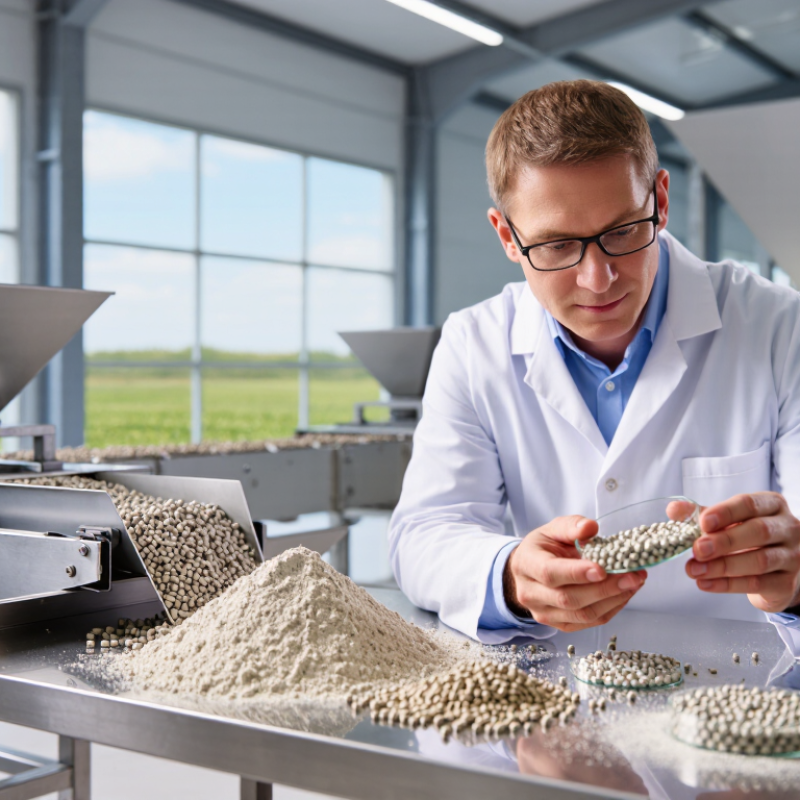
What Fertilizer Granulation Means
What Fertilizer Granulation Means
Fertilizer granulation turns fine powders or nutrient-rich mixtures into larger, more uniform particles called granules. It is not simply pressing dust into balls. Moisture, heat, binders, and mechanical movement help particles join, depending on the ingredients and equipment. Some producers use a rotating drum, where damp material gathers into small spheres. Others compact dry powders, then break and screen them into usable sizes. The details matter.
A finished granule should be sturdy enough to handle without crumbling, yet able to release nutrients after application. Size affects how particles flow through spreading equipment and distribute across a field. Picture a handful poured from a bucket: consistent granules tend to move more evenly than dusty fines mixed with oversized lumps. Too much moisture can create sticky clumps; too little may leave weak particles. Small changes in feed rate or temperature can shift the result.
Granulation does not guarantee better fertilizer. A batch may look neat but still vary in nutrient content or break during transport. Producers check particle size, strength, moisture, and nutrient distribution, then adjust the process when readings drift. These checks help, though no single setting works for every formulation. That part is easy to underestimate.
How Granules Are Formed
Why Is Fertilizer Granulation Important?
How Granules Are Formed
Granules often begin as fine powders moving through a rotating drum or pan. Sprayed water or binder makes tiny particles stick together. These nuclei grow as more powder coats their damp surfaces. Think of a snowball, but the motion and moisture must be controlled. Too little liquid leaves dusty fines; too much creates sticky lumps. Small nuclei matter.
The granules then dry and cool before screens separate them by size. Fines and oversized pieces are commonly crushed or returned to the process. The European Commission’s 2007 reference document on large-volume inorganic chemicals describes screening and recycle as parts of fertilizer granulation. Many commercial products target particles around 2–4 mm, though the desired range depends on the product and spreading equipment.
This process has real scale. The International Fertilizer Association’s 2024 outlook estimated global fertilizer consumption at about 205.8 million tonnes of nutrients in 2023/24. That figure makes consistent production consequential: uneven granules can segregate during handling, so nutrient distribution may become less uniform. Yet “perfect” size is not the whole story. Moisture, strength, and abrasion resistance matter too, and a plant may trade one for another. I would not assume a smooth-looking batch will spread evenly without testing.
How Granulation Improves Fertilizer Handling
Granulated fertilizer is easier to move, store, and apply than many fine powders. Uniform particles flow more steadily through hoppers and augers, so operators spend less time breaking up clumps or clearing blocked outlets. Less dust, too. That can mean cleaner floors and fewer clouds around bag-filling or spreading equipment.
Granules also help keep application more even. When particle sizes and weights are reasonably consistent, they are less likely to separate during transport, which can reduce uneven nutrient distribution across a field. A spreader operator can check the pattern in a collection tray and adjust the settings. Small details matter: damp granules may still bridge in a bin, while weak ones can break into fines after rough handling.
Handling benefits depend on the product and conditions. Granules exposed to moisture can cake, and oversized particles may not spread like the rest. A quick inspection before loading can reveal dust, crushed material, or hard lumps. It is tempting to assume granulation solves every handling problem; it does not. But well-made, properly stored granules generally make routine handling more predictable.
How Granule Size Affects Nutrient Delivery
Granule size affects how evenly fertilizer reaches the soil. In a spinner spreader, larger or denser granules may travel farther than smaller ones. If a blend contains sharply different sizes, the ingredients can separate during handling, leaving uneven nutrient patterns across a field. Some rows may receive more than intended; others may receive less.
Small differences matter. A tray test can reveal gaps in the spread pattern before application. Check whether granules fall consistently across the working width, and adjust the spreader setting when needed. Very fine particles may also drift in wind, while oversized granules can land unevenly at shorter distances. These effects depend on granule density, spreader design, and weather, not size alone.
Size also influences how quickly nutrients become available. Smaller granules generally expose more surface area to moisture and may dissolve faster, while larger granules can take longer under the same conditions. Coatings, soil moisture, and temperature can change that timing. It is easy to assume that one size suits every field, but that is rarely a safe shortcut. Match the product’s size range to the spreader, then check distribution in the actual field. The result may still vary with wind or uneven ground.
Why Is Fertilizer Granulation Important? How Granule Size Affects Nutrient Delivery
Smaller granules have more surface area per unit mass, which can influence how quickly nutrients dissolve when moisture is available.
Illustrative geometric comparison for spherical granules of equal density. Relative surface area is calculated as 3 mm granule surface area per unit mass = 1. This is a surface-area comparison, not a measured nutrient-release rate; formulation, coatings, soil, and moisture also affect nutrient delivery.