
China’s Natural Rubber supply chain includes plantation groups, processors, and trading companies. Their strengths differ by product, origin, and delivery capability. The International Rubber Study Group’s World Rubber Industry Outlook, published in 2024, projected global natural rubber production at about 14.9 million tonnes that year, against consumption near 15.6 million tonnes. These figures are forecasts, not final results. Still, they show why buyers watch supply reliability closely.
A supplier’s name alone tells little. Buyers should examine grade consistency, processing capacity, traceability, and the ability to deliver latex, technically specified rubber, or smoked sheets on schedule. China’s producers also operate within a market shaped by imported raw material and changing global prices. That matters. This guide introduces major Chinese suppliers and explains what distinguishes them, while treating “top” as a practical comparison rather than a definitive ranking. Public company disclosures and industry data can clarify scale, but they do not always reveal current contract volumes or customer-level performance. So some conclusions require caution. A polished product page cannot replace a recent quality certificate, a clear origin record, and a realistic delivery commitment. Buyers should verify those details directly before choosing a partner.
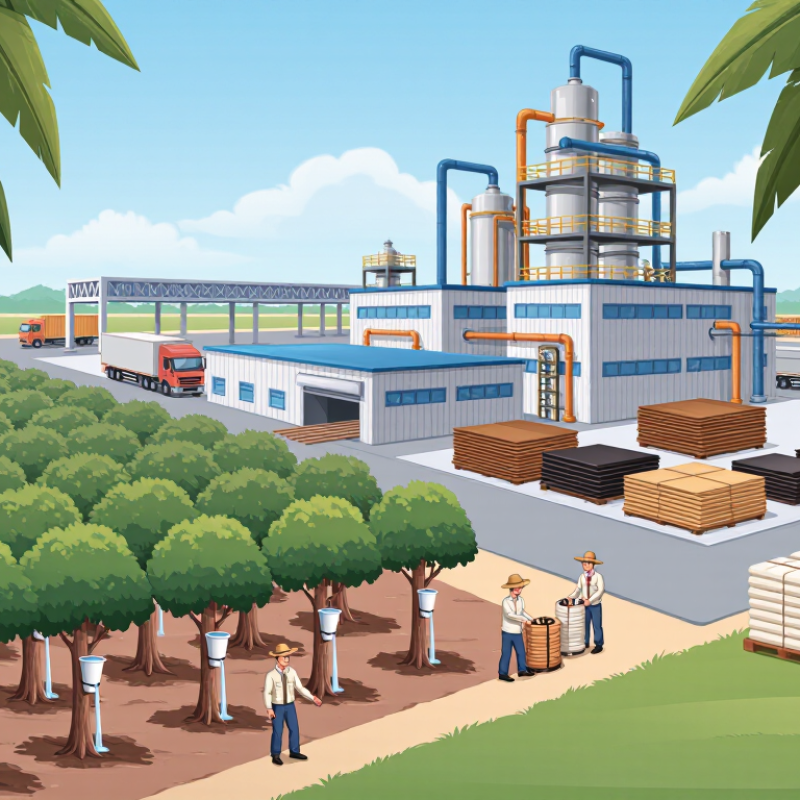
A leading natural rubber supplier in China is defined by consistency, not simply low pricing. The International Rubber Study Group’s World Rubber Industry Outlook 2024 projected global rubber demand would grow by 2.3% that year. This forecast covers natural and synthetic rubber, but it signals pressure on sourcing, inventory, and delivery planning. A capable supplier should explain how it manages these risks, rather than promise uninterrupted supply without evidence.
Quality needs measurable proof. Ask for recent batch certificates showing key properties, such as dirt content, volatile matter, and plasticity retention index. Check that testing methods and grade descriptions align with recognized specifications, including ISO 2000 for technically specified natural rubber. Traceability matters too: records should connect each shipment to its processing source and production lot. Clear answers are useful. Vague assurances are not.
Practical performance counts. Compare sample results with delivered batches, review shipment records, and confirm packaging protects rubber from moisture and contamination. Ask how the supplier handles seasonal changes in latex quality and unexpected delays. A polished spreadsheet cannot reveal every weakness. Even strong suppliers may have gaps in documentation; the important question is whether they acknowledge them and provide a realistic corrective plan.
China’s natural rubber supply is rooted mainly in Hainan and Yunnan, with smaller growing areas in Guangdong and Guangxi. Warm, humid conditions support rubber trees, but harvests vary with rainfall, temperature, and tree age. In Hainan, plantations and processing facilities often sit close to collection points. That shortens the first leg. Yunnan’s production is spread across inland tropical counties, where roads and seasonal transport can shape delivery times.
At collection stations, fresh latex is checked and processed into forms such as technically specified rubber or sheets. It then moves through processors, warehouses, and trading channels toward manufacturers. Some supply chains are regional; others connect inland production with coastal industrial centers. Factories in eastern and southern China create steady demand. Ports also bring in imported material when domestic supply falls short. Networks are not always smooth.
For buyers, origin alone says little about consistency. Harvest timing, moisture control, grading, and storage all affect usable quality. A reliable supplier should explain batch records and handling, not just name a province. That detail matters. Heavy rain, labor shortages, and road delays can disrupt regional flows. These risks deserve checking before a contract is fixed.
China’s natural-rubber supply comes from several distinct groups. Plantation operators in Hainan and Yunnan provide locally grown field latex and cup lump. Their output supports nearby processors, which turn raw material into saleable grades for tire, hose, and footwear manufacturers. Importers and trading firms fill the seasonal gap, sourcing from major Southeast Asian producing regions and arranging shipment, inspection, and warehousing. These roles overlap; a supplier may process domestic rubber while trading imported grades.
Market scale explains why sourcing is rarely local only. The Association of Natural Rubber Producing Countries reported global natural-rubber production of about 14.5 million tonnes in 2023. China is both a producer and a major industrial consumer, so domestic output alone cannot meet demand. Regional plantations offer shorter transport routes and traceable origin, while import-oriented suppliers can provide broader grade availability. Buyers should compare technical specifications, moisture and impurity limits, consistency between lots, and delivery terms—not price alone. A low quotation can still mean costly variability.
Tips: Ask for recent test results and a retained sample from the same production lot. Confirm whether the quoted grade is plantation-grown, processed domestically, or imported; documentation can be imperfect, so verify details before contracting.
Comparing Chinese natural rubber suppliers starts with grade, not the quoted price. Ask for the exact grade specification, moisture range, dirt content, and bale weight. A sample can look clean while a full shipment varies. Request recent test reports and compare them with an independent laboratory result when the application is sensitive. Check whether the stated grade suits your processing needs, not just its label.
Capacity needs evidence. Ask about monthly output, typical lead time, and stock actually available. A large figure in a brochure means little if production depends on one collection region or seasonal buying. Review shipment records, packaging photos, and contingency plans for delays. If possible, start with a modest trial order and track consistency across several lots. This is not perfect; small trials may not reveal peak-season constraints. Keep it measurable.
Tips: Compare at least three recent lots, not just one sample. Record batch numbers, inspection dates, and delivery deviations. Ask who handles claims and how quickly replacement decisions are made. Clear answers help, but polished promises are not proof.
| Comparison area | What to compare | Evidence to request | Practical evaluation |
|---|---|---|---|
| Product grade | Confirm whether the offer is for technically specified natural rubber (TSR), ribbed smoked sheet (RSS), or concentrated natural-rubber latex. These are different product forms and should not be compared as interchangeable grades. | Quotation stating the exact grade, applicable specification or standard, packing form, and agreed test methods. | Compare quotations only after matching grade, specification, packaging, and delivery terms. |
| TSR quality | For grades such as TSR 20, compare the contract limits for dirt, ash, nitrogen, volatile matter, and plasticity retention index (PRI). Limits depend on the governing specification and contract. | Recent certificate of analysis (COA), sampling details, and independent pre-shipment test results where required. | Check that every reported result meets the buyer’s stated limits; do not rely on a grade name alone. |
| RSS quality | For grades such as RSS 3, review the agreed visual classification, sheet cleanliness, consistency, and permitted defects. RSS is visually graded, so inspection criteria should be explicit. | Written grade specification, representative samples or inspection photographs, and a pre-shipment inspection procedure. | Agree on inspection and rejection rules before placing an order. |
| Latex specifications | For concentrated latex, confirm the required dry rubber content (DRC), preservation system, and relevant quality parameters. A nominal 60% DRC is commonly used for concentrated natural-rubber latex, but the contract specification governs. | COA showing DRC and other agreed test results, plus product handling, storage, and shelf-life information. | Match the latex type and preservation requirements to the buyer’s process and import rules. |
| Available capacity | Separate the supplier’s stated monthly availability from its verified production or sourcing capacity. Availability can vary by grade, season, inventory, and shipment schedule. | Written monthly allocation, current stock confirmation, lead time, and evidence of previous shipments of comparable size. | Compare confirmed tonnes available for the required shipment window—not an unsupported annual capacity claim. |
| Supplier role and traceability | Establish whether the counterparty is a producer, processor, exporter, or trading intermediary, and identify the product’s declared country of origin. | Business and export documentation, certificate of origin where applicable, and a clear chain of custody for the offered lot. | Check that the contracting entity, payment beneficiary, and shipping documents are consistent. |
| Delivery reliability | Compare realistic lead times, shipment frequency, port arrangements, packing, and the supplier’s record of meeting agreed delivery windows. | Shipment references or redacted shipping records, agreed Incoterms® rule, packing details, and a documented delivery schedule. | Assess performance against the buyer’s destination, order size, and required arrival date. |
| Commercial and compliance checks | Review payment terms, contract remedies for off-spec goods, applicable import requirements, and any buyer-specific sustainability or due-diligence requirements. | Signed sales contract, inspection and claims clauses, required declarations, and relevant compliance documents. | Use the same contract, inspection, and payment assumptions when comparing supplier offers. |
This comparison framework does not rank individual companies. Grade limits, test methods, and documentation requirements should be confirmed in the purchase contract and checked against the applicable standard and destination-market rules.
China’s natural-rubber supply outlook depends on domestic harvests, import flows, and changing weather patterns. Domestic production is concentrated in Hainan and Yunnan, where tapping seasons and rainfall affect how much latex reaches processors. A dry spell can reduce output; heavy rain can interrupt tapping and transport. A late season matters. Small shifts can tighten nearby supply.
Imports help fill the gap. Shipments from Southeast Asian producing regions are influenced by harvest conditions, freight capacity, and port schedules. Delays can leave factories waiting even when rubber is available elsewhere. Buyers also track inventories and grades, since not every shipment suits every production process. Quality varies.
Weather is only part of the picture. Tire and manufacturing demand can change purchasing pace, while prices influence how much material buyers hold in stock. Checking origin, grade, and delivery timing gives a clearer view than relying on headline prices alone. Still, forecasts have limits: local rainfall and shipping delays can quickly alter short-term availability. A forecast can be wrong.
| Cookie | Duration | Description |
|---|---|---|
| cookielawinfo-checkbox-analytics | 11 months | This cookie is set by GDPR Cookie Consent plugin. The cookie is used to store the user consent for the cookies in the category "Analytics". |
| cookielawinfo-checkbox-functional | 11 months | The cookie is set by GDPR cookie consent to record the user consent for the cookies in the category "Functional". |
| cookielawinfo-checkbox-necessary | 11 months | This cookie is set by GDPR Cookie Consent plugin. The cookies is used to store the user consent for the cookies in the category "Necessary". |
| cookielawinfo-checkbox-others | 11 months | This cookie is set by GDPR Cookie Consent plugin. The cookie is used to store the user consent for the cookies in the category "Other. |
| cookielawinfo-checkbox-performance | 11 months | This cookie is set by GDPR Cookie Consent plugin. The cookie is used to store the user consent for the cookies in the category "Performance". |
| viewed_cookie_policy | 11 months | The cookie is set by the GDPR Cookie Consent plugin and is used to store whether or not user has consented to the use of cookies. It does not store any personal data. |
| Key Principles | Criteria |
| Environment |
|
| CSR Policies and Reporting |
|
| Social Investment Programmes |
|
| Key Principles | Criteria |
| Quality of Product |
|
| Quality of Factory |
|
| Quality of Management |
|
| Key Principles | Criteria |
| Monitoring and Control |
|
| Management |
|
| Key Principles | Criteria |
| Global Presence |
|
| Logistical Assets |
|
| Terminal Handling |
|
| Key Principles | Criteria |
|
Tapping and Field Latex |
|
|
Concentrated Latex Processing, Handling & Storage and Shipping |
|
|
Laboratory & Chemical Handling |
|
|
EHS Management System |
|
| Key Principles | Criteria |
|
Monitoring and Mitigating Key Impacts |
|
|
Social Responsibility |
|
|
Social Investment |
|
| Key Principles | Criteria |
|
Security Controls |
|
|
Security Certification |
|
| Key Principles | Criteria |
|
Quality of Raw Material |
|
|
Quality of Process |
|
|
Quality of Management |
|
| Key Principles | Criteria |
| Certified Team |
|
| Technical Expertise |
|
| Key Principles | Criteria |
| International Standards and Certification |
|
| Customised Products |
|
| Testing |
|
| Key Principles | Criteria |
| Security Controls |
|
| Security Certification |
|